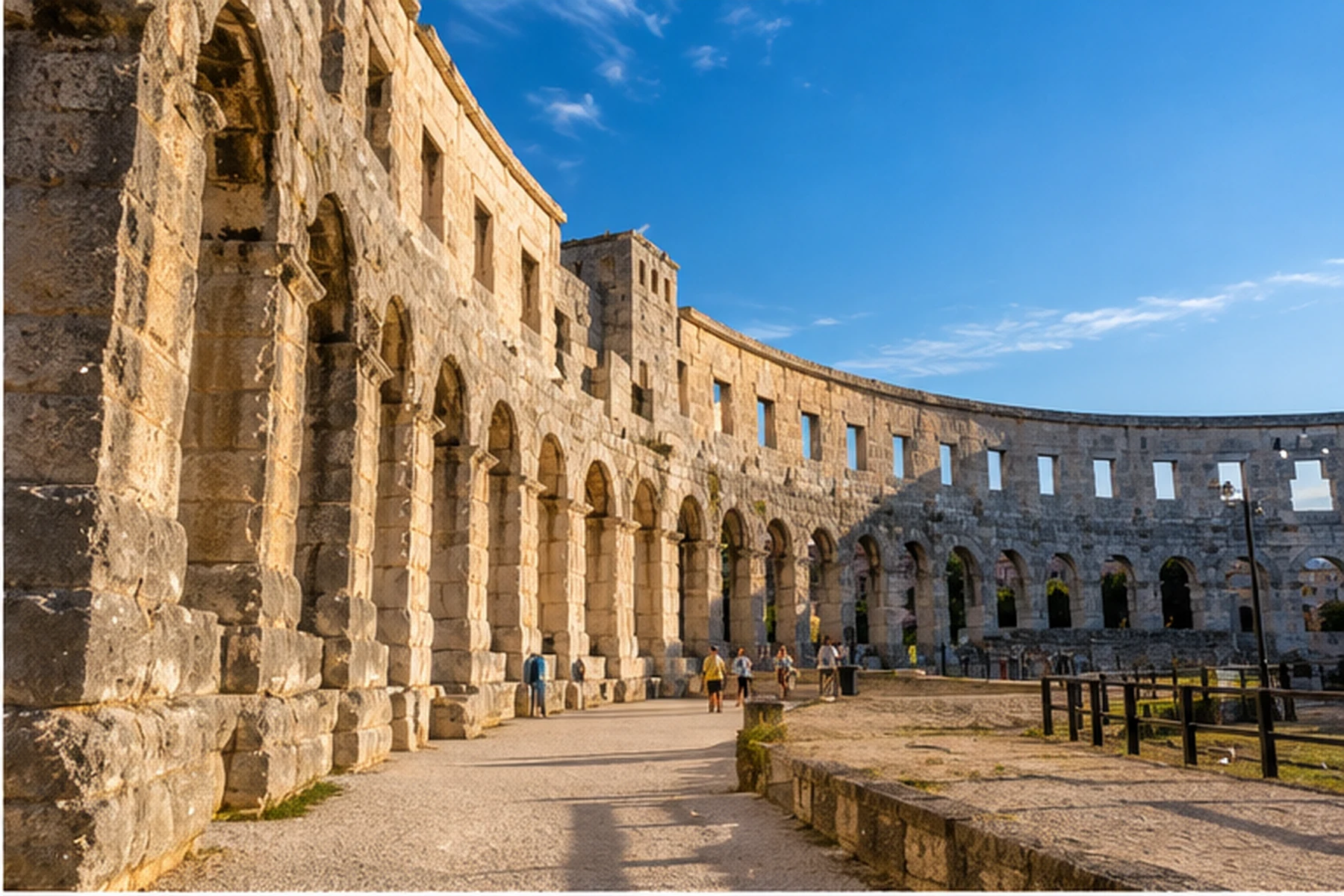
What the Arena staged, how audiences were organized and what the evidence actually supports.
What happened in the Arena
The Archaeological Museum of Istria states that gladiatorial fights and animal hunts were organized in the amphitheatre. Public trials and punishments also formed part of the broader Roman spectacle culture associated with the arena.
Spectacle and social order
Admission in antiquity could be free, but seating was not socially equal. The official museum description emphasizes that spectators were arranged according to hierarchy. The architecture therefore managed both entertainment and the visible ordering of Roman society.
The arena floor
The central oval measured about 67.9 by 41.6 metres. Beneath it was an auxiliary subterranean chamber used for technical equipment. The combination of visible performance space and hidden service infrastructure is essential to understanding how the building functioned.
Avoid modern mythmaking
Popular culture tends to project a single dramatic image of gladiators onto every amphitheatre. A stronger interpretation separates what is documented for Pula from generic Roman spectacle. ArenaPula.com follows museum and archaeological sources for that reason.